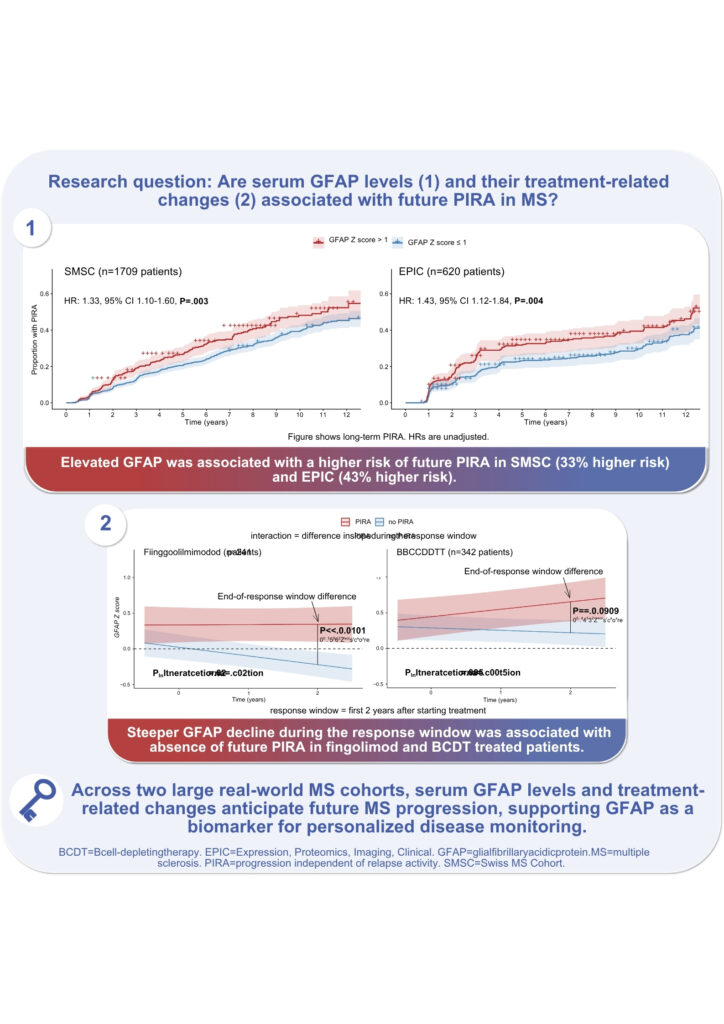
Researchers from the Research Center for Clinical Neuroimmunology and Neuroscience Basel (RC2NB) and Neurology at the University Hospital Basel, the University of Basel, and an international network of collaborators have published a new study in JAMA Neurology demonstrating that the blood biomarker glial fibrillary acidic protein (GFAP) can help identify people with multiple sclerosis (MS) at increased risk of disability progression while also providing valuable insight into treatment response. The findings represent an important step toward more personalized disease monitoring and the development of therapies targeting MS progression.
The study analyzed 18,629 blood samples collected from 2,329 people with MS enrolled in two large longitudinal cohorts: the Swiss Multiple Sclerosis Cohort (SMSC; www.smsc.ch) and the Expression, Proteomics, Imaging, Clinical (EPIC) study at the University of California, San Francisco. Researchers investigated whether changes in serum GFAP could identify patients at risk of progression independent of relapse activity (PIRA), one of the major contributors to long-term disability in MS. "By analyzing nearly 19,000 blood samples collected over many years, we were able to demonstrate that elevated GFAP levels are associated with an increased risk of future disability progression, while reductions in GFAP following treatment are associated with improved clinical outcomes. These findings highlight the importance of longitudinal biomarker monitoring and bring us a step closer to more personalized care for people living with MS," said Dr. Maximilian Einsiedler, first author of the study.
GFAP (Serum Glial Fibrillary Acidic Protein (GFAP) Reference App) complements neurofilament light chain (NfL) (Serum Neurofilament Light Chain Reference App), an established biomarker of disease activity, by capturing biological processes related to chronic disease progression. Together, these biomarkers provide a more comprehensive picture of the disease. "Our study shows that GFAP has the potential to improve how we monitor disease evolution, personalize treatment decisions, and design more efficient clinical trials targeting progression," said Prof. Jens Kuhle, corresponding and senior author.
Key findings
• 18,629 blood samples from 2,329 people with multiple sclerosis were analyzed across two independent international cohorts (SMSC and EPIC).
• Elevated serum GFAP was associated with a significantly higher risk of progression independent of relapse activity (PIRA).
• Treatment-related reductions in GFAP were associated with a lower risk of subsequent disability progression.
• GFAP complements neurofilament light chain (NfL), providing additional information on progression-related disease biology.
• GFAP-based patient selection may improve the efficiency of future clinical trials targeting MS progression.
This study represents an important advance toward precision medicine in MS, by improving risk stratification, informing treatment decisions, and supporting the development of therapies targeting disease progression. As blood-based biomarkers become increasingly integrated into clinical practice and clinical trials, GFAP could become an important tool for monitoring disease progression and evaluating treatment response.
Publication
Einsiedler M, Sandgren S, Schaedelin S, et al. Serum Glial Fibrillary Acidic Protein Dynamics and Multiple Sclerosis Progression. JAMA Neurology. Accepted for publication June 7, 2026. DOI and publication link will be added upon online publication.
Read full study: