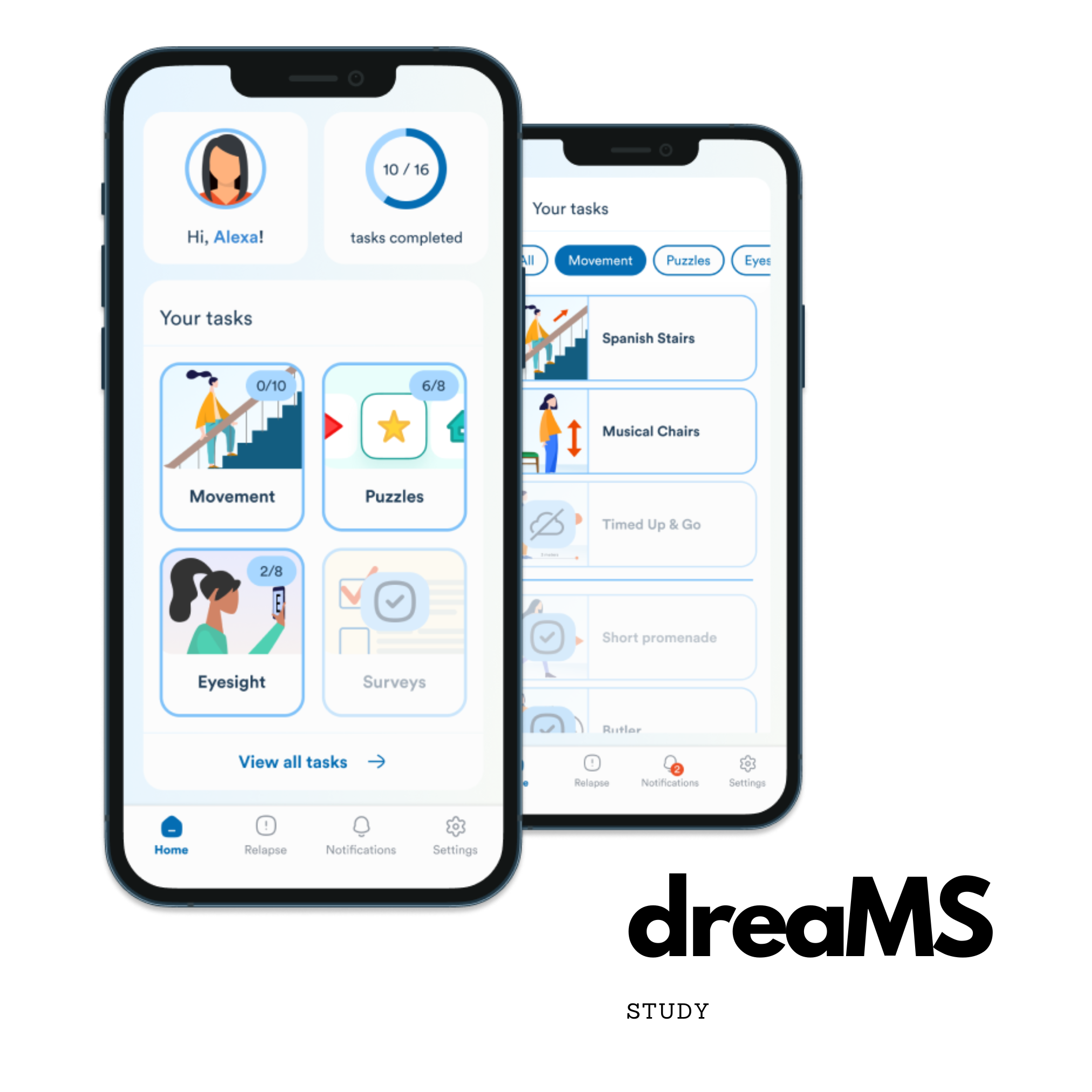
More than 50 people with multiple sclerosis support the development of the novel dreaMS digital health app, by participating in a clinical validation study led by the Research Center for Clinical Neuroimmunology and Neuroscience Basel (RC2NB).
The dreaMS app provides so-called digital biomarkers, measurements of health status and disease progression collected in the usual everyday life in a real-world environment by using a smartphone. Digital biomarkers aim to detect subtle disease progression earlier and more comprehensively, thus complementing standard assessments by neurologists, laboratory or neuroradiological examinations. The dreaMS app is part of a digital platform for optimized disease management to better involve patients and improve the communication with their health care team. DreaMS and the digital platform are developed jointly by the RC2NB and Healios AG, Basel.
The DreaMS validation study started in April 2022, and with the enrollment of 50 patients, has now reached an important milestone.
Participants in the dreaMS study install the dreaMS app on their own smartphone and digital biomarkers are then collected over a period of 2 years. This digital information will be compared with state of the art established clinical, imaging, and body fluid assessments obtained in the framework of the Swiss MS Cohort Study over the study period. Good agreement would indicate high validity of the digital biomarkers. Digital biomarkers are expected to allow earlier and more comprehensible detection of subtle disease progression and in the future allow to tailor treatment more individually.
PD Dr Johannes Lorscheider, PI of this study, said, ‘The DreaMS validation study will provide valuable information on the reliability and accuracy of monitoring disease evolution and treatment response with a digital app. With validated digital biomarkers, we hope to further improve the care of our patients.’
Professor Ludwig Kappos, director of the RC2NB said, ‘We are very grateful to all our collaborators, funders and partners who are supporting us at RC2NB to explore this fascinating future field and to find and establish generally accepted digital measures for better care of persons with MS and other neurological diseases’.
The news has also been published by the University Hospital Basel on their website.