Basel, 6 October 2026
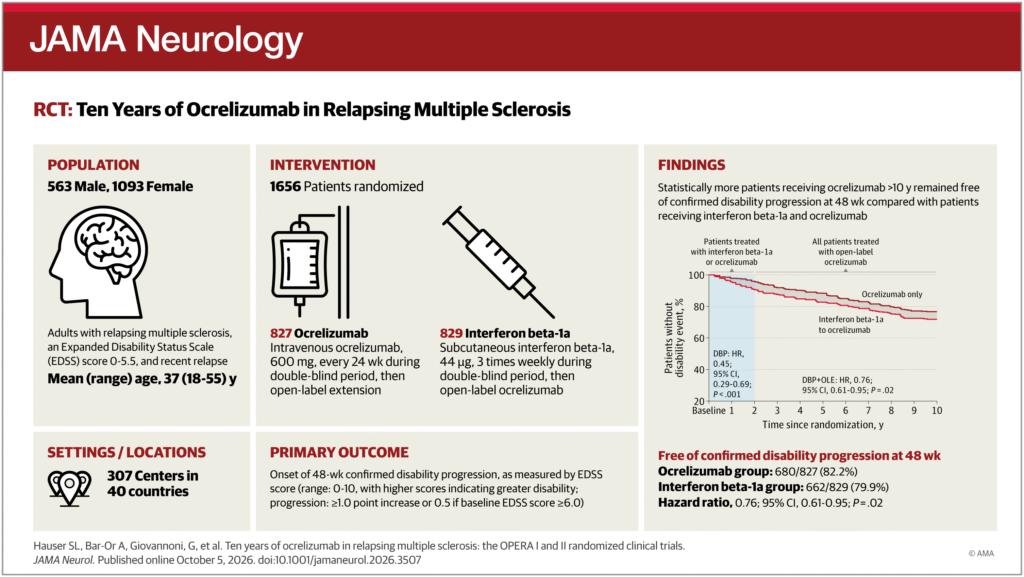
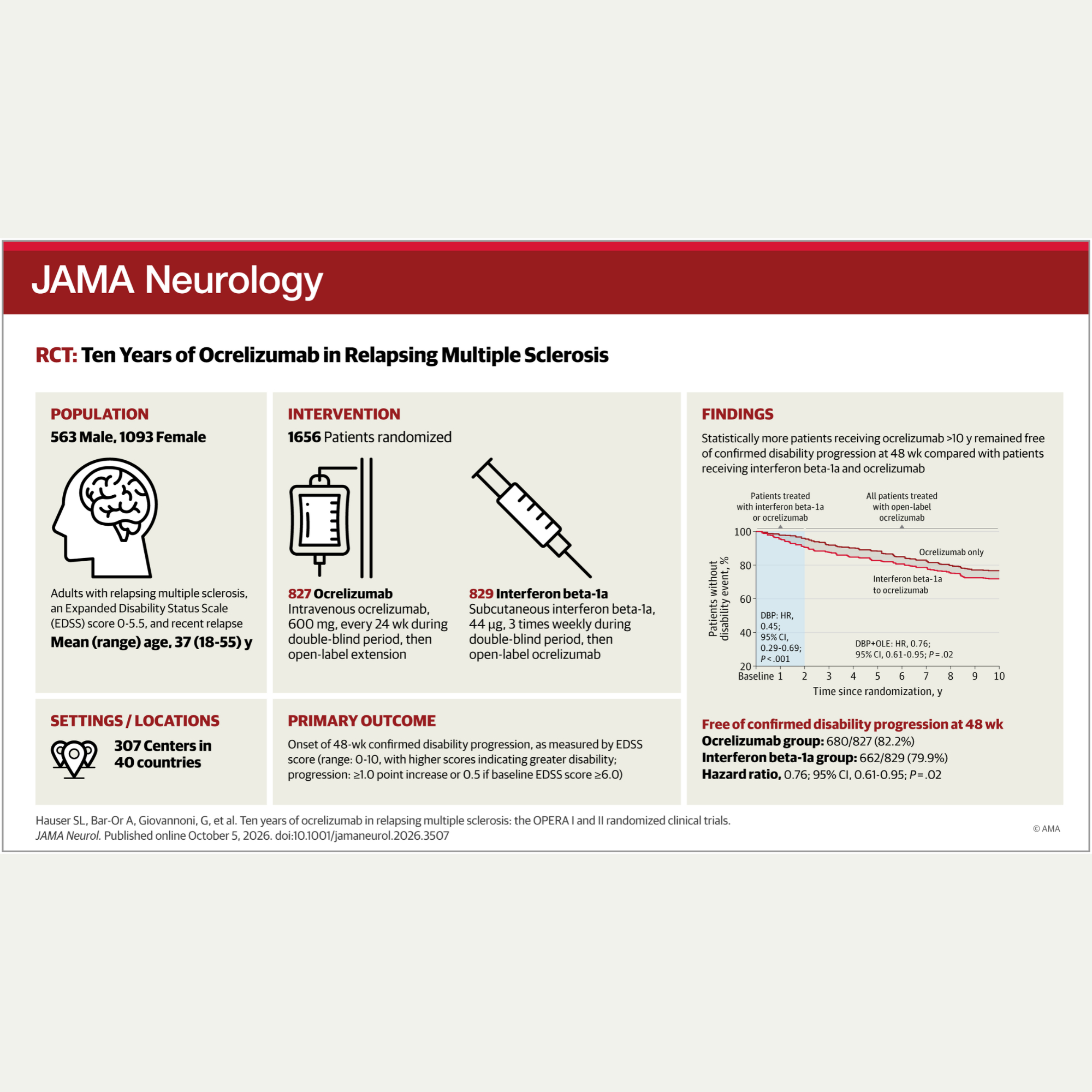
The 10-year results of the OPERA I and II trials were published in JAMA Neurology on 5 October 2026. Prof. Ludwig Kappos of RC2NB is senior author of the study, which followed people with relapsing multiple sclerosis (MS) for a full decade.
The study
OPERA I and II were two identical phase 3 trials run in 307 centres in 40 countries. A total of 1,656 adults with relapsing MS were randomised to ocrelizumab or interferon β-1a for a two-year double-blind period. After that, all participants could receive ocrelizumab in an open-label extension lasting eight more years. 1,325 participants (80%) entered the extension and 853 completed it. This design makes it possible to compare people who started ocrelizumab from the outset with those who started it two years later.
Key findings
- Continuous ocrelizumab lowered the risk of 48-week confirmed disability progression by 24% over 10 years, compared with delayed initiation (hazard ratio 0.76; 95% CI 0.61–0.95; P = .02).
- After 10 years on continuous ocrelizumab, 82% of participants remained free of confirmed disability progression and 86% remained free of progression independent of relapse activity (PIRA).
- The risk of reaching an EDSS score of 6.0, the point at which a walking aid is needed, was 43% lower with continuous treatment (hazard ratio 0.57; 95% CI 0.40–0.82; P = .002). 94% of participants stayed below this milestone.
- Relapses became rare: the annualised relapse rate fell from 0.139 in year 1 to 0.016 in year 10.
- Rates of adverse events and serious adverse events, including serious infections, did not increase over the eight-year extension.
What it means
The authors conclude that continuous ocrelizumab treatment over 10 years preserved function better than starting two years later, which reinforces the importance of early high-efficacy treatment in relapsing MS.
>>> Read the full article here